


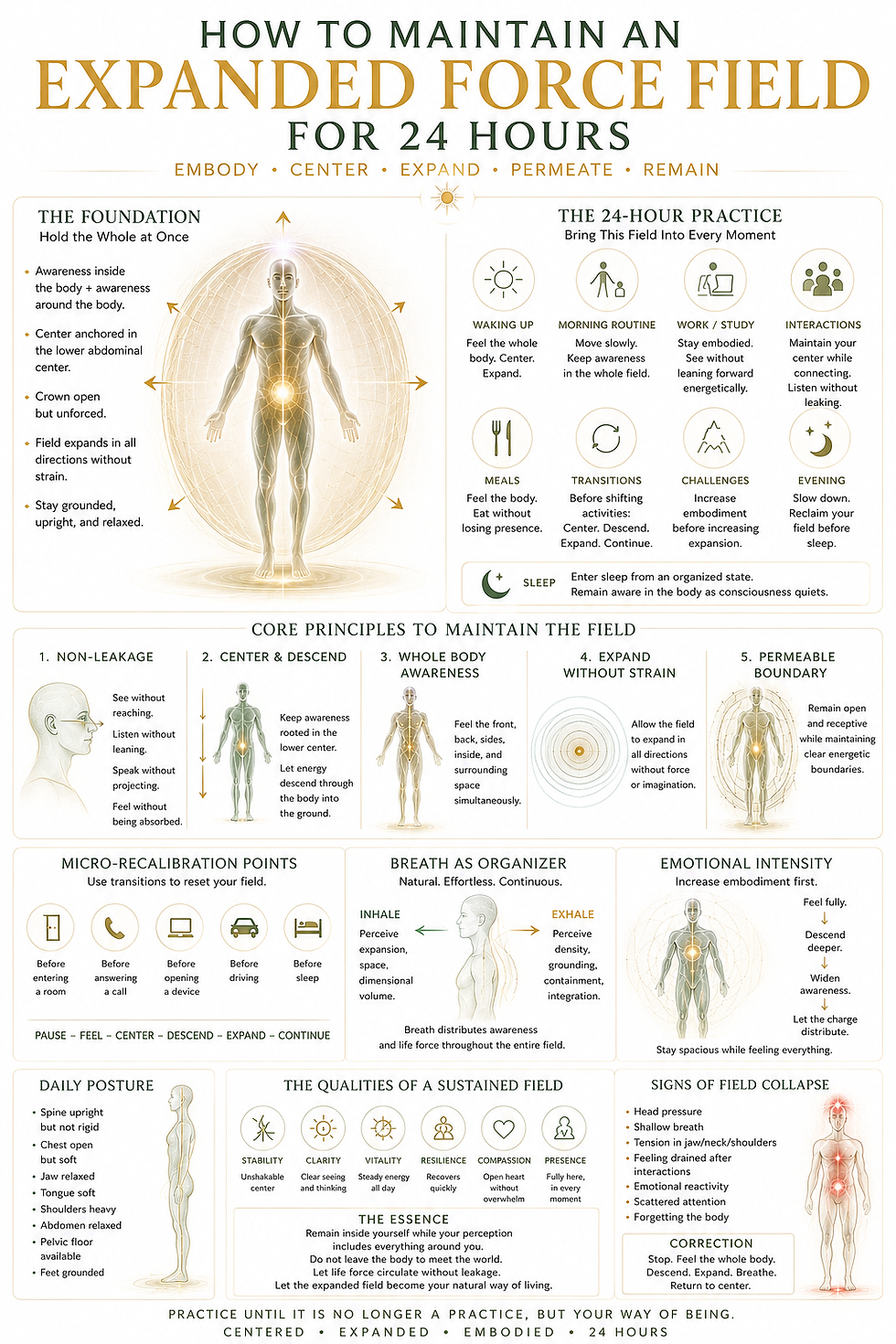
How to Maintain an Expanded Force Field for 24 Hours
- GERALDINE OROZCO

- 4 hours ago
- 9 min read
The difficulty begins after practice. In stillness, under favorable conditions, the field may expand. The breath becomes quiet, the body settles, and a larger space is felt. But the moment ordinary life returns, the field is forgotten, narrowed, or unconsciously given away.
This is the real test.
At an advanced level, the question is no longer whether one can create an expanded force field in practice. The question is whether one can remain inside it while living. The field must not be an event. It must become the condition in which speech, work, eating, walking, rest, and sleep take place.
This requires a different kind of effort. It is not muscular. It is not emotional enthusiasm. It is the sober effort of divided attention, presence in the body, and non-leakage of force.

The field must become continuous with life
Many people make a mistake at this point. They attempt to preserve the sensation of practice by becoming tense. They hold the breath slightly, fix the attention, stiffen the face, or withdraw from ordinary contact.
This does not maintain the field. It creates an imitation.
A real field is alive. It can speak, listen, move, answer a question, prepare food, receive an impression, and remain itself. It does not need retreat from life, though periods of retreat may strengthen it. The aim is more exacting: to bring the cultivated state into the disorder of the day.
The body must become the practice.
This means there is no clean separation between spiritual work and ordinary action. Washing a cup, answering a message, walking through a store, or lying down at night all reveal whether the field has continuity.
If awareness disappears when the circumstance changes, the field was dependent on circumstance. If awareness remains, even in a modest degree, something more stable has begun.
Hold inner body and surrounding space at once
Begin with a simple division of attention.
One part of attention rests inside the physical body. It senses weight, pressure, warmth, breath, bones, organs, and the quiet vibration of living tissue. Another part senses the space surrounding the body, in front, behind, above, below, and to both sides.
Do not project outward.
Projection is one of the first causes of leakage. The attention jumps toward the object, toward a person, toward a screen, toward a sound. A thread of force goes out and attaches itself. Soon the body is forgotten. The field collapses into the object of attention.
Nor should one strain to hold a perimeter. A forced boundary becomes another form of tension. It is a thought about space, not space itself.
Let the body be felt from within. Let the surrounding space be included.
These two perceptions must coexist.
Expansion without embodiment
Embodiment without spatial awareness
The force diffuses. One becomes vague, ungrounded, and easily influenced.
The force contracts. One becomes dense, narrow, and self-enclosed.
The advanced state holds both. The center remains in the body, while awareness includes the whole field.
This cannot be done by imagination alone. It must be verified in direct sensation. Feel the soles of the feet. Feel the lower abdomen. Feel the back of the body. Then, without leaving these sensations, include the space around the body.
This is the beginning of continuity.
Keep the lower center weighted and the upper body free
When attention rises into the head, the field becomes unstable. Thoughts multiply, the face tightens, the eyes harden, and the breath becomes shallow. A person may still believe they are present, but the force has moved upward and become thin.
The correction is not to push energy downward by force. It is to allow descent.
Let the jaw soften. Let the tongue rest. Let the throat be open. Let the chest and diaphragm stop defending themselves. Let the abdomen receive breath. Let the pelvic floor and feet be included.
The lower center must feel weighted, not heavy in a dull way, but substantial. It is like the base of a flame lamp. Without this base, the flame shakes.
The upper body must remain unforced. A quiet vertical axis can then appear. It is not a posture invented by the mind. It arises when the body is neither collapsed nor held rigidly.
During the day, return often to these points:
Feel the feet without looking at them.
Sense the lower abdomen from inside.
Notice whether the throat is contracting.
Release the eyes from their habit of grasping.
Let the back body participate in awareness.
Sense the space behind you as clearly as the space in front.
The back body is especially important. In ordinary waking sleep, attention goes forward. It pursues, reacts, anticipates. When the back body is remembered, something in the organism stops rushing ahead of itself.

Watch where life force follows attention
The day is full of small thieves.
A conversation can take force. A screen can take force. A memory can take force. A future event can take force before it arrives. A room can take force. Another person’s emotional atmosphere can take force if one unconsciously leans into it.
The problem is not contact. Life requires contact. The problem is identification.
Attention goes out, and force follows it. Soon one is no longer seeing, but caught. No longer listening, but inwardly leaning. No longer responding, but being pulled.
The discipline is to observe this movement without condemnation.
When you notice that force has gone out, return at once. Do not make a drama of it. Do not think about your failure. Thinking about the loss of presence is often another loss of presence.
Make the correction directly:
Feel the feet
Let attention enter the soles, heels, toes, and the contact with the ground.
Feel the lower abdomen
Do not tighten it. Sense it as a living center of gravity.
Feel the back body
Include the spine, shoulder blades, back of the ribs, sacrum, and back of the skull.
Feel the space behind you
This reverses the forward fall of attention.
Reopen the circumference
Include the whole field without leaving the body.
The correction must be immediate and quiet. No one need know that it is taking place. It must be possible in the middle of speech, while walking, while buying groceries, or while listening to another person.
This is what distinguishes actual work from a state produced only under special conditions.
Practice non-leakage in every perception
Non-leakage does not mean closing oneself. It means perceiving without losing force.
See without Searching.
Listen without leaning.
Speak without pushing.
Receive impressions without being swallowed by them.
When the eyes grasp, energy goes out through the eyes. When the ears strain, energy goes out through listening. When speech becomes excessive, energy pours into words. When emotion becomes identification, the field tears open and force moves toward the object of reaction.
The first sign of leakage is a subtle forward movement. It may be almost invisible. The head moves slightly. The chest follows. The attention stretches outward like a hand.
At that moment, remain.
Let the object come to awareness. Do not send yourself toward it.
This distinction is delicate, but decisive. One can look at a tree while remaining in oneself. One can hear another person speak while remaining rooted in the body. One can feel emotion without becoming the emotion.
The field is not maintained by isolation. It is maintained by right relation.
In right relation, the center remains itself while impressions are received. There is contact, but not expenditure. There is sensitivity, but not collapse.
Use ordinary actions as continuous tests
A 24-hour field is not maintained by one long act of concentration. Few can do this, and attempting it usually produces fatigue. It is maintained through repeated returns, short renewals, and gradual coherence.
Ordinary actions provide exact tests.
Walking reveals whether the field moves with you
Do not walk as a head carried by legs. Sense the movement of the whole body through space. Let the soles of the feet, the pelvis, the spine, and the surrounding air be included.
As you walk, feel that the field moves as one body. Not a shell, not a fantasy, but a unified sphere of awareness rooted in sensation.
Eating reveals whether the field contracts into appetite
Before the first bite, sense the body. Sense the space around the body. Eat without hurry. Notice when attention collapses into taste, craving, or thought.
The aim is not austerity. The aim is inclusion. Eating can take place inside presence.
Conversation reveals whether the field leaks through identity
In conversation, one often wants to be seen, understood, admired, defended, or agreed with. These wants pull force outward.
Listen from the whole body. Speak from the lower center. Do not rush to fill silence. If irritation or eagerness appears, include it in sensation rather than expressing it mechanically.
Rest reveals whether the field depends on activity
Many can maintain awareness while doing. Fewer can maintain it while resting. The moment activity stops, dreams of the day begin. Thought takes the unused force.
Rest with the body open, the breath unforced, and the space included. Let the organism recover without abandoning presence.

Protect the passage into sleep and waking
The field over 24 hours depends greatly on two thresholds: falling asleep and waking.
At night, lie down and sense the whole body. Do not narrow attention to the head. Let awareness include the feet, legs, pelvis, abdomen, chest, hands, throat, face, and the space around the bed.
There is no need to force wakefulness. Let sleep come. But let the last impression be whole-body awareness, not scattered thought.
This changes the quality of sleep. The aim is not to control dreams or produce special experiences. The aim is to reduce the violent break between practice and unconsciousness.
On waking, do not immediately give yourself to memory, plans, or the phone. Before movement, sense the body. Feel the weight of the body in bed. Feel the breath. Feel the back. Feel the room.
Then rise without abandoning the field.
The first moments of the day set the direction of force. If attention immediately goes outward, the work begins with recovery. If attention first enters the body, the day begins with continuity.
Do not confuse tension with containment
A common error appears when one tries to maintain the field for long periods. The person begins to hold.
The face becomes serious. The breathing becomes controlled. The shoulders become firm. The pelvis tightens. The attention watches itself anxiously. This state has intensity, but it lacks freedom.
Containment is not contraction.
A contained field is spacious, not rigid. It has boundary, but not hardness. It has center, but not self-importance. It can adapt without dissolving.
Ask during the day:
Is the body becoming tense in the name of practice?
Has attention risen into the head?
Am I trying to maintain an image of myself as present?
Can I soften without losing the field?
Can I include more space while staying embodied?
The field is maintained through living elasticity. It must breathe.
Renew the field through three-minute recollections
Although the aim is continuity, the organism needs conscious renewals. A short recollection repeated many times is more useful than heroic strain.
Use three minutes whenever possible.
For the first minute, sense the body from within. Feet, legs, pelvis, abdomen, back, chest, hands, throat, and head.
For the second minute, include the space surrounding the body. Do not leave the body. Let space be known at the same time as sensation.
For the third minute, observe the direction of attention. See where it wants to go. Let it return to the whole without violence.
Then continue the activity.
This can be done before a call, after driving, before eating, after a difficult exchange, before sleep, or upon waking. These short returns stitch the day together. Gradually, the gaps become smaller.

Let the field serve presence, not self-image
There is a subtle danger in speaking of an expanded force field. The idea can feed imagination. One may begin to picture oneself as powerful, luminous, protected, or superior.
This is already collapse.
A true field is not vanity. It is a condition of finer responsibility. The more force is conserved, the more exact one must become in thought, speech, action, and feeling.
If the field is real, it should make a person less reactive, less wasteful, less compelled by every impression. It should bring sobriety, warmth, and clear perception. It should not create theatrical behavior or spiritual self-importance.
The measure is practical.
Can presence remain during irritation?
Can awareness remain while speaking?
Can the body stay sensed while the mind works?
Can the field include another person without absorbing their state?
Can sleep and waking become part of the same practice?
These questions are better than any fantasy of attainment.
For guided support in energetic practice and healing work, you can explore the upcoming Energy Reading and Healing Clinic.
What 24-hour maintenance looks like
To maintain an expanded force field for 24 hours does not mean that no interruption occurs. It means that interruption is seen sooner, corrected more quietly, and allowed less authority.
Success is not a dramatic state. It is a new relationship to ordinary life.
The body is remembered more often. The lower center remains present. The back body is not forgotten. The space around the body is included. Speech wastes less. Listening leans less. Seeing grasps less. Emotional reactions are sensed before they take command.
One begins to understand that the field is not held by force, but by conscious participation.
The practice continues while walking, eating, working, speaking, resting, and sleeping. The separation between cultivation and life grows thinner. At moments, it disappears.
Then the body itself begins to practice.
if you would your energy body read sign up for me energy reading and healing clinic.
once a month space is limited.
my deepest love
Geraldine Orozco

Comments